
Agentic AI 2026: The Complete Guide to Autonomous AI Agents & Multi-Step Workflows
Agentic AI is the defining enterprise shift of 2026. Unlike chatbots that answer questions, autonomous AI agents plan, call tools, and complete multi-step workflows on their own. This guide explains the agentic AI architecture, ten real enterprise use cases, what it costs to build, the biggest risks, and how to deploy it safely.
Agentic AI is the defining enterprise technology shift of 2026. For the past two years, AI meant chatbots that answer questions and copilots that suggest drafts. Agentic AI is a different category entirely: autonomous agents that set a goal, break it into steps, call tools and APIs, run workflows, and report back when the work is done. They do not merely suggest. They act.
In 2026, enterprises are moving from 'ask an AI' to 'delegate to an AI', and the shift is visible everywhere: support desks that close tickets end to end, sales workflows that qualify and follow up automatically, DevOps that repairs incidents before a human notices, and coding agents that ship entire features. This guide is the practical, no-hype playbook for agentic AI, what it is, the ten use cases actually delivering ROI, the architecture behind it, what it costs, the risks, and how to deploy it safely.
Quick Answer: What Is Agentic AI?
Agentic AI is an AI system built on autonomous agents, software programs powered by a large language model that can perceive their environment, reason about a goal, choose actions, call external tools, and iterate until the objective is met. Where generative AI produces content, agentic AI produces outcomes. The agent is the unit of work, and orchestrator agents coordinate teams of specialist agents.
The evidence is real
Leading enterprises report 30 to 60 percent reductions in routine workflow time, 20 to 40 percent cost savings in back-office operations, and faster incident resolution with agentic AI. But the same leaders warn that unmanaged autonomy, without guardrails and governance, is how agents go wrong. Governance and orchestration are not optional.
What Is Agentic AI? A Clear Definition
The simplest way to understand agentic AI is to contrast it with what came before. A chatbot is passive: you ask, it answers, and the conversation ends. An agentic AI agent is active: you give it a goal, and it plans, executes, verifies, and iterates until the goal is achieved. The difference is the loop between acting and observing the result.
| Capability | Traditional Chatbot | Agentic AI Agent |
|---|---|---|
| Interaction style | Question answering | Goal-oriented task execution |
| Does it call tools / APIs? | Rarely | Yes, continuously |
| Plans multi-step tasks? | No | Yes, decomposes goals |
| Works across systems? | Limited | Connects apps and data |
| Iterates and self-corrects? | No | Yes, checks and retries |
| Completes work end to end? | No | Yes, under supervision |
| Output | Text answer | Completed outcome |
DID YOU KNOW?
The agentic AI market is projected to grow from roughly $2 to $7 billion in 2024 to well over $30 billion by 2030, as enterprises shift budgets from 'AI-assisted' tools toward 'AI-operated' workflows.
How Agentic AI Works: The Agent Loop
Every agentic AI system runs on the same core loop. Understanding this loop is the key to designing agents that work reliably rather than agents that fail unpredictably.
- Perceive: The agent ingests a goal plus context, from the user, a queue, an event, or another agent.
- Plan: It decomposes the goal into sub-steps and decides what to do first.
- Act: It calls a tool, API, function, or another agent to perform an action.
- Observe: It reads the result of that action, including errors and unexpected outputs.
- Reason: It evaluates whether the outcome matches the plan, and whether the goal is met.
- Iterate: It retries, adjusts, or escalates until the goal is satisfied or a limit is reached.
The power and the danger both come from this loop. Left unsupervised, an agent can keep calling expensive tools, make irreversible changes, or follow a hallucinated plan. Designed well, with guardrails, budget limits, and human checkpoints, the same loop compresses weeks of manual work into minutes.
The Agentic AI Architecture
Production agentic AI systems share a common five-layer architecture. Whether you buy a platform or build in house, understanding these layers tells you where value is created and where risk lives.
Layer 1: The Reasoning Core (LLM)
The model that plans and reasons. In 2026 the strongest agentic systems pair a powerful reasoning model with lightweight task-specific models, routing complex planning to one and routine classification to another to control cost and latency.
Layer 2: Planning and Goal Decomposition
The layer that turns 'close this support ticket' into a concrete sequence of steps. Modern agents use structured planning, reflection on outcomes, and re-planning when results deviate from expectations.
Layer 3: Tool and Function Calling
The agent's hands. Tools include APIs, database queries, web search, internal systems, email, and code execution. Function calling is what transforms an AI from a talker into a doer. Permission scoping here defines what the agent is allowed to touch.
Layer 4: Memory
Short-term memory tracks the current task's context. Long-term memory stores past interactions, user preferences, and learned domain knowledge so the agent improves over time instead of starting from zero each run.
Layer 5: Orchestration and Governance
The control plane that schedules agents, routes work, enforces policies, tracks audit logs, applies budget and rate limits, and manages human checkpoints. In multi-agent systems this layer is indispensable: without it, multiple agents produce conflicting outputs, lost context, and runaway cost.

Single Agent vs Multi-Agent Systems
Many early agentic pilots are single agents that handle one workflow. As deployments mature, they become multi-agent systems where an orchestrator routes work among specialist agents. The distinction matters for both capability and cost.
| Dimension | Single Agent | Multi-Agent System |
|---|---|---|
| Scope | One workflow or task | Cross-functional, end-to-end processes |
| Specialization | Generalist on one job | Specialist agents per domain |
| Coordination | None needed | Orchestrator routes and merges |
| State management | Simple | Shared context and handoffs |
| Cost | Lower | Higher, but more transformative |
| Risk | Moderate | Higher without governance |
| Best for | A repetitive, bounded task | Complex business processes |
PRO TIP
Start with a single bounded agent, prove the ROI, instrument observability, and only then expand to a multi-agent system. Trying to build a multi-agent platform on day one is how most agentic AI programs stall.
Top Agentic AI Use Cases for Enterprise (2026)
Every worthwhile use case has the same shape: a repetitive, multi-step, rules-heavy workflow where an agent can add real value and where outcomes are verifiable. Here are the ten use cases delivering measurable ROI in production today.
1. Customer Service Resolution
Agentic support agents resolve complete tickets, not just answer questions. They read the ticket, look up the account, run diagnostics, apply fixes within their permissions, and escalate only what they cannot handle. Companies report resolving 60 to 80 percent of routine tickets without human touch, with follow-up actions executed automatically.
2. Lead Qualification and Sales Operations
Sales agents qualify inbound leads, enrich them with firmographic data, score readiness, draft personalized outreach, and update the CRM. They keep working between human touches, so no lead slips through. Sales teams report 2 to 3 times more qualified pipeline from the same marketing spend.
3. IT and DevOps Automation
AI agents monitor systems, triage alerts, and repair common incidents, failing over a service, restarting a stuck job, or rolling back a bad deploy, before a human even opens the dashboard. Response times drop from hours to minutes, and on-call engineers focus on novel problems.
4. Back-Office and Finance Automation
Agents reconcile invoices, match purchase orders to payments, process accounts payable exceptions, and generate month-end reports. Finance teams cut close time from weeks to days and reduce manual entry errors dramatically.
5. AI Coding and Software Delivery
Coding agents generate and modify code, run tests, fix failures, review pull requests, and scaffold entire features from a ticket. Developer teams that adopt coding agents report measurable productivity gains, but code review and human ownership remain essential for quality and security.
6. Data Analysis and Reporting
Analyst agents connect to data sources, run queries, generate dashboards, summarize findings, and produce narrative reports. They turn 'someone needs to pull this report' from a multi-day request into a minutes-long automated process that runs on schedule.
7. Supply Chain and Procurement
Agents track inventory, forecast demand, compare supplier pricing, place reorder requests within thresholds, and flag exceptions. They reduce stockouts and overstock by keeping planning continuous rather than weekly.
8. HR and Onboarding
Agents handle the mechanics of onboarding, provisioning accounts, scheduling training, gathering documents, and answering common policy questions, so new hires are productive on day one while HR focuses on the human side.
9. Claims and Document Processing
In insurance, fintech, and healthcare, agents extract data from documents, validate it against policies, apply decision rules, and route to review. Processing time drops from days to minutes with a clear audit trail of every automated decision.
10. Marketing Campaign Orchestration
Agents segment audiences, personalize creative, schedule multi-channel campaigns, and measure performance, then adjust content and budget automatically toward the highest-ROI segments. Marketing teams gain always-on optimization without expanding headcount.
Agentic AI Costs: How Much Does It Cost to Build?
Cost is the question every CTO asks, and the honest answer is range between a single agent and a full enterprise platform. Below are realistic figures based on production builds, not vendor slide decks.
| Scope | Typical Cost | Timeline | Includes |
|---|---|---|---|
| Proof of concept | $8K – $20K | 2 – 4 weeks | One workflow, single agent, sandbox integrations |
| Single production agent | $15K – $40K | 4 – 8 weeks | Guardrails, memory, tool integration |
| Multi-agent system | $60K – $150K+ | 2 – 4 months | Orchestration, governance, observability |
| Enterprise platform | $150K – $500K+ | 4 – 9 months | Cross-functional agents, compliance, deployment |
Beyond build cost, plan for ongoing operational spend: model API fees, agent runtime hosting, observability tooling, and human-in-the-loop review. For a moderately active system expect $2,000 to $20,000 per month, scaling with the volume of work the agents handle.
PRO TIP
The largest hidden cost in agentic AI is not the build. It is ungoverned runtime: runaway loops that burn tokens, agents that call expensive tools too often, and rework from hallucinated steps. Budget limits and observability pay for themselves several times over.
Measuring Agentic AI ROI
The strongest metric for agentic AI is time saved per workflow, converted to dollars. Measure a workflow's manual hours before deployment, then measure the hours worked after, and multiply by loaded labor cost.
- First-contact resolution: what share of tickets resolve without human touch?
- Cycle time: how much faster is the end-to-end workflow?
- Cost per transaction: what does one unit of work cost before and after?
- Human time released: how many hours per month are freed for higher-value work?
- Error rate: does the agent reduce or introduce errors over time?
- Escalation accuracy: are escalations to humans the right ones?
The ROI trap
Do not measure agentic AI by 'responses generated'. A chatbot can generate a million responses and create zero value. Measure completed outcomes, resolved tickets, shipped features, and closed work. Outcome metrics are the only honest way to justify agentic investment.
Agentic AI Risks and How to Control Them
Agentic AI multiplies both the value and the blast radius of AI mistakes. Because agents act on real systems, an autonomous error can have real consequences. Every production deployment needs a risk framework.
COMMON MISTAKES
- Deploying agents with no human checkpoints on irreversible or high-risk actions.
- Giving agents access to more tools and data than they need, instead of least privilege.
- No budget or rate limits, so a runaway loop burns months of API spend.
- Ignoring prompt injection, where malicious content causes an agent to take unintended actions.
- No audit log of what the agent did, why it did it, and who approved it.
- Planning, the single state, and 3rd party evaluation, treating agents as a black box with no observability.
- Letting agents access production without a rollback path for their changes.
Hallucination and Unintended Consequences
An agent can confidently follow a wrong plan. The controls are validation layers, confirmation gates on destructive actions, human review of high-impact outputs, and unit tests for agent behavior.
Data Leakage and Prompt Injection
Agents interact with untrusted data, emails, web pages, and user input that can contain hidden instructions. Mitigate by isolating untrusted content, sanitizing inputs, and defining strict tool permission scopes so an agent cannot exfiltrate sensitive data.
Uncontrolled Cost
Autonomous loops are excellent at spending money. Set hard budget caps per task, per day, and per agent; put rate limits on expensive tools; and alert when spend deviates from baseline.
Compliance and Auditability
Regulated industries need to prove what the AI did and why. Keep immutable audit logs, capture the reasoning trail for decisions, and build human approval checkpoints into workflows where compliance demands a human signature.
Building Agentic AI Guardrails
Put these guardrails in place before any agent goes to production
- Define a least-privilege tool policy: the agent can only call the tools it needs.
- Set budget and rate limits on every agent and every tool.
- Add human approval gates for irreversible actions (payments, deletions, public writes).
- Sanitize and isolate untrusted input to prevent prompt injection.
- Maintain an immutable audit log of agent actions and decisions.
- Set a maximum iteration and timeout so no agent loops forever.
- Stage a rollback path for every automated change.
- Evaluate agents against a test suite before and after every update.
How to Build an AI Agent Step by Step
Here is the build sequence that works in production, whether you use a platform or custom engineering. Each step reduces risk before you spend money on the next.
- Pick one narrow workflow with a measurable baseline. Do not start with 'automate everything'.
- Map the steps, tools, and decisions a human performs today. The agent will replicate this loop.
- Select the model and tools. Start with a proven reasoning model and the fewest tools possible.
- Prototype the agent loop in a sandbox with mocked tools.
- Add guardrails and human checkpoints on high-risk steps.
- Run it in shadow mode alongside the human process, comparing outcomes.
- Instrument observability: logs, cost, success rate, and escalation accuracy.
- Deploy to a sub-set of traffic, measure, then scale.
- Operate: monitor, evaluate against the test suite, and roll back on regressions.
Build vs Buy: Agentic AI Platforms in 2026
The market now spans agent-building frameworks, orchestration platforms, and full no-code agent builders. Each has a place, and hybrid approaches are common.
- Orchestration platforms: best for coordinating many agents and governed, enterprise-wide workflows.
- Agent frameworks: best for developers who want code-level control over custom agents.
- Low-code agent builders: best for business teams prototyping quickly, but harder to govern at scale.
- Custom engineering: best where the workflow, integration breadth, or compliance needs are unique.
Hybrid is the pragmatic default: buy a platform for standard back-office workflows, invest custom engineering only where the workflow touches your customers or competitive advantage. If you are still deciding what to automate versus rebuild, read our comparison of AI agents versus traditional automation.
Does Agentic AI Require New Talent?
You do not need a team of AI researchers to ship agentic AI, but you do need people who understand agent design, prompt engineering at the agentic level, tool integration, and the discipline of evaluation and governance. Most organizations staff this as a mix of senior engineers, a product owner, and a governance or compliance stakeholder.
PRO TIP
The scarcest skill is not building the agent. It is defining the guardrails and evaluation criteria that make the agent trustworthy. Hire for that discipline first and you will outpace teams with bigger models and bigger budgets.
The Future of Agentic AI: What Comes Next
By late 2026 and into 2027, expect agents to become more reliable memory of past work will improve, orchestration standards will reduce vendor lock-in, and enterprise governance frameworks will mature so that autonomous agents become a normal part of the operating model rather than a pilot. The teams that invest now in evaluation, orchestration, and governance will hold the durable advantage.
The direction is clear: AI is moving from tools that assist people to agents that operate processes. Organizations that treat agentic AI as a governed engineering discipline, not a buzzy experiment, will compound the advantage. Those that skip the guardrails will learn the lesson at the worst time.
Conclusion: Treat Agentic AI as Governed Infrastructure
Agentic AI in 2026 is not a futuristic idea. It is the fastest-moving shift in enterprise software, already resolving support tickets, automating back offices, fixing incidents, and shipping code under human supervision. The technology works. The differentiator is discipline.
The organizations that win with agents start with one bounded workflow, measure it honestly, instrument guardrails from day one, and expand only after proving the loop. They invest in orchestration and governance as seriously as in the models themselves.
If you are planning your agentic AI strategy, start with a candid conversation about which workflows to automate, what guardrails you need, and what ROI you will measure. That conversation is free, concrete, and grounded in what we build for enterprises every day. Let us take you from agent pilot to governed, autonomous operations.
Book a Free Agentic AI Discovery Call
We will map your highest-value workflows, assess which are ready for autonomous agents, and scope a governed proof of concept with real ROI targets. No jargon, no pitch, just a concrete plan.
Book My Free Discovery CallExplore Our AI Agent Development Services
From single production agents to governed multi-agent platforms, see how we build agentic AI that ships and scales.
View AI Agent ServicesKEY TAKEAWAYS
- 1Agentic AI uses autonomous agents that plan, call tools, and complete multi-step workflows, unlike chatbots that only respond.
- 2The agent loop, plan, act, observe, reason, iterate, is both the source of value and the source of risk.
- 3Ten enterprise use cases are delivering ROI today, led by customer service, sales ops, DevOps, finance, and coding.
- 4A single production agent costs roughly $15K to $40K; multi-agent systems run $60K to $150K+ plus ongoing operating cost.
- 5Guardrails (least privilege, budget limits, human checkpoints, audit logs) are non-negotiable before production.
- 6Start with one bounded workflow, measure outcomes honestly, then scale into an orchestrated multi-agent system.
Frequently Asked Questions
Agentic AI refers to AI systems built around autonomous agents that can plan, make decisions, and act on multi-step tasks with limited human supervision. An agentic AI agent perceives its environment, reasons about a goal, selects tools to call, and iterates on results until the task is complete.
Written by DiVentra Team
The DiVentra Labs engineering team designs and builds AI orchestration platforms, enterprise AI solutions, and intelligent automation for businesses worldwide. We help CTOs and engineering leaders turn disconnected workflows into governed, self-improving systems.
Engineering Insights in Your Inbox
Get practical guides on AI, custom software, and digital transformation. No spam, unsubscribe anytime.
Related Reading

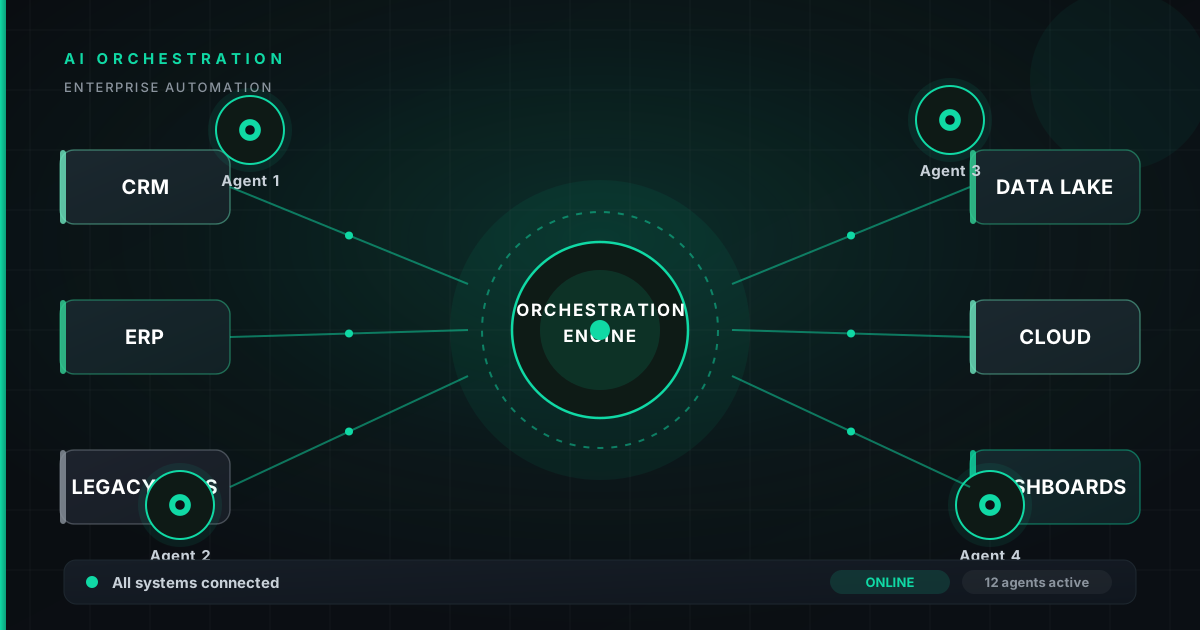
Where individual agents end and the orchestration layer begins — the distinction that matters for production.
A hands-on comparison of purpose-built platforms, agent frameworks, workflow engines, and cloud-native stacks.
A practical field manual for building a governed enterprise AI strategy that compounds.
What autonomous multi-agent systems mean for your organisation between now and 2030.