Multi-Agent AI Systems: Orchestrating Teams of Specialized Agents That Work Together
Multi-agent AI systems coordinate specialised agents to solve complex problems no single model can handle alone. A guide to architectures, orchestration, and patterns that work in production.
Single AI agents are powerful, but they have limits. A single model trained on general data cannot be an expert in every domain, handle every type of input, and make every decision equally well. The most ambitious AI systems in 2026 solve this problem by combining multiple specialised agents into a coordinated team. Each agent plays a distinct role, and together they accomplish tasks that no single model could handle reliably.
Multi-agent AI systems represent a shift from building one large model that does everything to building a system of focused models that collaborate. This architecture mirrors how human teams work: specialists communicate, delegate, and hand off work. The result is more robust, more explainable, and more adaptable than monolithic AI systems.
This guide covers the architectures, orchestration patterns, frameworks, and real world use cases for multi-agent AI systems. Whether you are evaluating the technology or preparing to build a production system, the principles here will help you design agents that work together effectively.
What Are Multi-Agent AI Systems?
A multi-agent AI system is a collection of autonomous or semi autonomous AI agents that interact to solve problems that exceed the capability of any single agent. Each agent has a defined role, a specific set of capabilities, and access to certain tools or data sources. Agents communicate through messages, shared state, or an orchestration layer. They can work sequentially, in parallel, or in a dynamic topology where the next step depends on the output of the previous one.
The key insight behind multi-agent systems is decomposition. A complex task like processing a mortgage application is broken into subtasks: identity verification, income assessment, property valuation, credit check, compliance review, and approval recommendation. Each subtask is handled by a specialised agent trained or configured for that specific job. The orchestrator manages the flow and handles exceptions.
This decomposition brings several benefits. Each agent can be optimised for its specific task, making the system more accurate overall. Failures are isolated to a single agent rather than derailing the entire process. The reasoning is more transparent because each step is handled by a known agent with a defined responsibility. And the system is easier to extend: adding a new capability means adding a new agent, not retraining the entire model.
Architectures for Multi-Agent Systems
There are several established patterns for structuring multi-agent systems. The right architecture depends on the workflow topology, the level of coupling between tasks, and the need for human oversight.
Sequential Chain
The simplest pattern processes tasks in a fixed sequence. Agent A completes its work and passes the result to Agent B, which passes to Agent C, and so on. This works well for pipelines where each step depends on the previous one, such as document ingestion, classification, extraction, and validation. The sequential chain is easy to implement and debug but does not support parallel work or dynamic routing.
Hub and Spoke
A central orchestrator agent receives the initial task, decomposes it, dispatches subtasks to specialist agents, collects results, and assembles the final output. The orchestrator handles routing, validation, and error recovery. This pattern is flexible and supports parallel execution because the spoke agents can work concurrently. The orchestrator becomes the single point of complexity, so its design and reliability are critical.
Graph Based
The most flexible pattern models the workflow as a directed graph where nodes are agents and edges represent possible transitions. The orchestrator evaluates the current state and decides which agent to invoke next based on the output of the previous step. This supports conditional branching, loops, and dynamic workflows. Graph based systems are harder to design but can handle complex, non deterministic processes. LangGraph is the leading framework for this pattern.
Conversational Mesh
Agents communicate through a shared message bus, similar to a chat channel. Each agent listens for messages relevant to its role and responds when it can contribute. This pattern works well for open ended tasks like research or analysis where the flow is not predetermined. The challenge is preventing agents from interfering with each other and ensuring that the conversation converges to a useful outcome.
| Architecture | Best For | Complexity | Flexibility |
|---|---|---|---|
| Sequential chain | Fixed pipelines, predictable workflows | Low | Low |
| Hub and spoke | Task decomposition with parallel subtasks | Medium | Medium |
| Graph based | Complex, conditional, dynamic workflows | High | High |
| Conversational mesh | Open ended research and analysis | High | Very high |
Orchestration Frameworks in 2026
Building a multi-agent system from scratch is possible but rarely advisable. Several mature frameworks handle orchestration, state management, communication, and error handling.
LangGraph
LangGraph, part of the LangChain ecosystem, provides a graph based framework for building stateful, multi agent applications. Agents are represented as nodes in a graph. Edges define transitions. The framework manages conversation history, tool execution, and conditional routing. LangGraph is the most popular choice for production systems because it supports complex workflows, integrates with the LangSmith observability platform, and has strong community support.
CrewAI
CrewAI takes a role based approach. You define agents with roles, goals, and backstories that guide their behaviour. Agents are organised into crews that collaborate on tasks. CrewAI is particularly well suited for scenarios where you want agents to behave like team members with distinct personalities and responsibilities. It is simpler than LangGraph for straightforward multi-agent scenarios but less flexible for complex orchestration patterns.
AutoGen
AutoGen, developed by Microsoft Research, focuses on conversational multi-agent interactions. Agents communicate through structured messages and can be configured with different capabilities, such as code execution, web search, or function calling. AutoGen excels at scenarios where agents need to iterate on a problem through discussion, such as a coding task where one agent writes code and another reviews it.
| Framework | Paradigm | Best Use Case | Learning Curve |
|---|---|---|---|
| LangGraph | Graph based state machine | Complex production workflows | Moderate to high |
| CrewAI | Role based collaboration | Team style task execution | Low to moderate |
| AutoGen | Conversational agents | Iterative discussion and refinement | Moderate |
Design Patterns for Multi-Agent Systems
Several patterns have emerged from real world multi-agent deployments. These patterns solve recurring problems and provide a starting point for new systems.
Validator Pattern
A primary agent performs a task and a validator agent reviews the output. If the validator finds issues, it sends the work back with feedback. This improves quality without requiring a single agent to handle both generation and verification. The validator can use different criteria, such as format compliance, factual accuracy, or policy alignment.
Research Then Write Pattern
A research agent gathers information from documents, databases, or web sources and produces a summary. A writer agent then formats the summary into the desired output, such as a report, email, or proposal. This separation lets each agent focus on its strength. The research agent can use retrieval augmented generation. The writer agent can focus on tone, structure, and audience.
Debate and Consensus Pattern
Multiple agents independently analyse the same input and produce recommendations. A consensus agent compares the outputs and reconciles differences. This pattern reduces bias and improves accuracy for tasks where judgement is involved, such as credit risk assessment, medical triage, or content moderation. The cost is higher latency and token consumption.
Production Challenges and Solutions
Multi-agent systems introduce challenges that single agent systems do not. Each challenge has known solutions that teams should plan for before going to production.
Latency and Cost Management
Every agent invocation consumes model inference time and tokens. A multi-agent workflow can easily make ten to fifty model calls for a single end user request. Mitigate this by using smaller, faster models for simple agents, batching parallel agent calls, caching intermediate results, and setting timeouts per agent. Monitor token usage per workflow and set budget alerts.
Consistency and Conflict Resolution
Different agents may produce contradictory outputs. The orchestrator should implement conflict resolution rules, such as preferring the output of a higher confidence agent, requiring consensus across multiple agents, or escalating conflicts to a human. Define these rules explicitly in the orchestration layer rather than relying on the model to resolve conflicts during generation.
Observability and Debugging
Debugging a multi-agent system is harder than debugging a single model because the reasoning is distributed. Each agent's input, output, reasoning trace, and tool calls must be logged and correlated. Use tools like LangSmith, LangFuse, or custom tracing that link child agent calls to parent workflow IDs. Build dashboards that show workflow completion rates, per agent latency, error distributions, and token cost per workflow.
Human in the Loop
For high stakes decisions, the system should pause and request human approval before proceeding. Design the orchestration layer to support approval workflows at configurable decision points. For example, a compliance agent may flag a transaction for review, and the workflow pauses until a human reviews the flag. The human should see the full reasoning chain across agents to make an informed decision.
Real World Use Cases
Financial Services: Loan Origination
A multi-agent system processes loan applications through specialised agents. An intake agent extracts and validates application data. A credit agent checks credit bureau reports and calculates scores. An income agent verifies payslips and bank statements. A compliance agent checks regulatory requirements. An underwriting agent assembles the findings and produces a recommendation. The system processes applications in minutes instead of days and maintains a full audit trail of every decision.
Healthcare: Clinical Trial Matching
Matching patients to clinical trials requires analysing medical records, trial protocols, inclusion criteria, and exclusion criteria. A multi-agent system uses a patient data agent to extract structured data from records, a trial search agent to identify relevant trials, an eligibility agent to match criteria, and a prioritisation agent to rank matches. The system surfaces options that human clinicians review. One organisation using this pattern reduced trial matching time from weeks to hours.
Legal: Contract Review and Due Diligence
A multi-agent system for contract review uses an ingestion agent to parse documents, a clause extraction agent to identify key terms, a risk assessment agent to flag problematic language, a compliance agent to check regulatory alignment, and a summarisation agent to produce a review memo. Each agent applies its specific expertise, and the output is more thorough than a single model review. Law firms using this pattern report 60% faster due diligence cycles.
Customer Operations: Intelligent Triage and Resolution
A front line agent triages incoming customer inquiries by intent and urgency. A knowledge agent searches documentation and past resolutions for answers. A resolution agent drafts responses. A quality agent checks the response against policy before sending. If the inquiry requires a refund, account change, or other action, an execution agent performs the action through the relevant API. Complex issues that cannot be resolved are escalated to a human with the full agent reasoning chain attached.
Getting Started With Multi-Agent Systems
Building a multi-agent system requires a different mindset than building a single agent application. Start with a workflow that is well understood, has clear inputs and outputs, and would benefit from decomposition. Map the workflow as a sequence or graph of steps and identify which steps could be handled by specialised agents.
Choose a framework that matches your workflow topology. Start simple with a sequential chain or hub and spoke architecture. Add validation agents, parallel execution, and conditional routing as you gain confidence. Invest in observability from day one. A multi-agent system without tracing is almost impossible to debug in production.
Most importantly, define success metrics before you build. Measure end to end accuracy, latency per workflow, cost per task, and human escalation rate. Use these metrics to decide where to add or remove agents, which models to use, and when human oversight is needed. Multi-agent systems are powerful, but they require disciplined engineering to deliver on their promise.
At DiVentra Labs, we design and deploy multi-agent AI systems for enterprise clients. From loan origination to clinical trial matching, our teams build agent architectures that are reliable, observable, and deliver measurable business outcomes.
For the full picture of how orchestration runs across your entire automation estate — not just multi-agent systems — read our guide to AI orchestration for enterprise automation, which covers platform architecture, governance, ROI measurement, and a phased implementation roadmap.
Build Your Multi-Agent System
Talk to our AI engineering team about designing a multi-agent architecture for your most complex workflow.
Start the ConversationKEY TAKEAWAYS
- 1Multi-agent systems decompose complex tasks into subtasks handled by specialised agents.
- 2Sequential, hub and spoke, graph based, and conversational are the four main architectures.
- 3LangGraph, CrewAI, and AutoGen are the leading orchestration frameworks in 2026.
- 4Validator, research then write, and debate and consensus are proven design patterns.
- 5Latency, cost, consistency, and observability are the main production challenges.
- 6Start with a well understood workflow, measure everything, and add complexity incrementally.
Frequently Asked Questions
A multi-agent AI system coordinates multiple specialised AI agents that each handle a specific capability such as research, analysis, coding, or validation. The agents communicate, share context, and hand off work to one another through an orchestration layer. This architecture handles complex workflows that would overwhelm a single general purpose model by decomposing them into subtasks managed by focused agents.
Written by DiVentra Team
The DiVentra Labs engineering team designs and builds AI orchestration platforms, enterprise AI solutions, and intelligent automation for businesses worldwide. We help CTOs and engineering leaders turn disconnected workflows into governed, self-improving systems.
Engineering Insights in Your Inbox
Get practical guides on AI, custom software, and digital transformation. No spam, unsubscribe anytime.
Related Reading

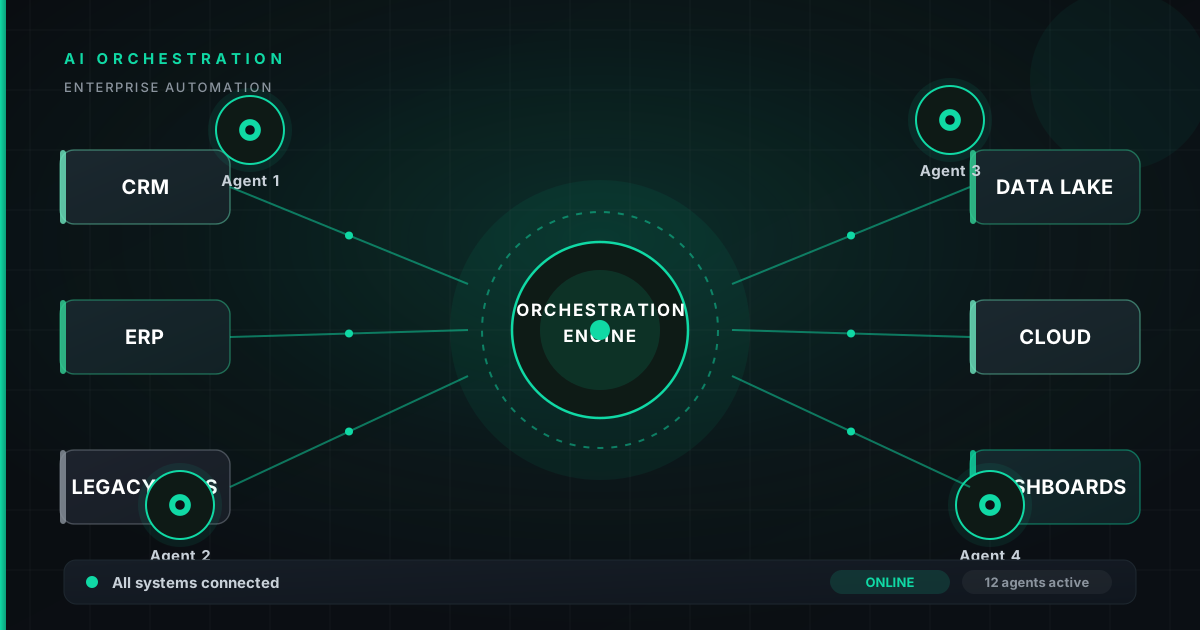
Where individual agents end and the orchestration layer begins — the distinction that matters for production.
A hands-on comparison of purpose-built platforms, agent frameworks, workflow engines, and cloud-native stacks.
A practical field manual for building a governed enterprise AI strategy that compounds.
What autonomous multi-agent systems mean for your organisation between now and 2030.