How AI Orchestration Is Transforming Enterprise Automation in 2026
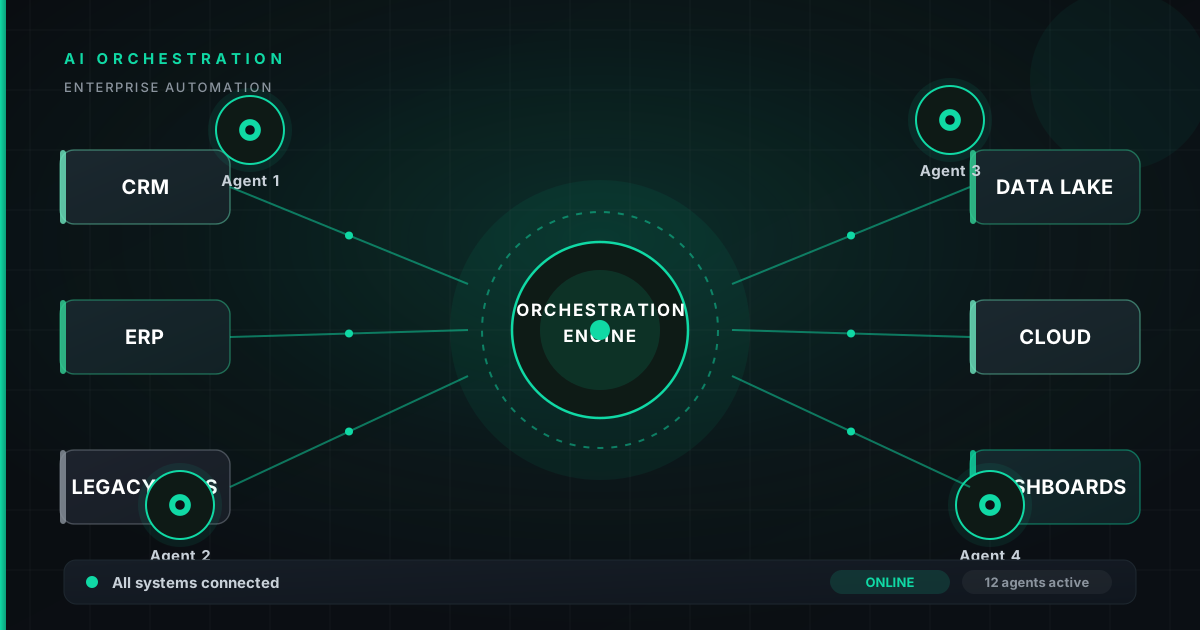
AI orchestration is the layer that turns scattered AI agents, models, and enterprise systems into one governed, self-improving automation platform. Here is how it is transforming enterprise automation in 2026.
Enterprise automation has entered a new era. For more than a decade, organisations automated with scripts, robotic process automation, and integration platforms. Those tools are still valuable, but they share a fundamental limit: they execute what humans have already decided. In 2026, AI orchestration is removing that limit by coordinating AI agents, foundation models, and enterprise systems into adaptive, governed, self-improving workflows. The result is a fundamental shift in how enterprises approach business process automation.
This guide is written for CTOs, CIOs, automation leaders, and engineering teams evaluating enterprise AI solutions. You will learn what AI orchestration is, why traditional automation is no longer enough, how a modern AI orchestration platform is architected, and exactly where it creates value across your organisation. We will cover real use cases in healthcare, finance, manufacturing, ecommerce, HR, customer support, logistics, and sales — and we will give you a pragmatic roadmap for AI transformation that avoids the hype.
If you are planning enterprise automation or AI workflow automation for the year ahead, read this guide before you buy another tool. AI orchestration is not a product category to bolt on; it is an architecture that determines whether your enterprise AI investment compounds or stalls.
We have structured the guide to work for both a 15-minute read and a deep study session. The key takeaways at the top capture the core argument. The sections on architecture, platforms, and the implementation roadmap give you enough detail to evaluate vendors and brief your engineering team. Wherever you start, the definitions in the next section give us a shared vocabulary for the rest of the discussion.
KEY TAKEAWAYS
- 1AI orchestration coordinates agents, models, and systems; it is the governance and control plane for enterprise AI.
- 2Traditional automation executes fixed rules; orchestration plans adaptive workflows and handles exceptions.
- 3The architecture has clear layers: approval, orchestration, intelligence, integration, security, and observability.
- 4ROI compounds when you score workflows by volume, variability, and impact — then pilot one bounded process.
- 5Governance, human approval, and monitoring are non-negotiable for production agentic AI.
What Is AI Orchestration?
AI orchestration is the coordination of AI agents, models, data, tools, and enterprise applications to execute complex workflows as a single governed system. Where a workflow engine tells a process which step runs next, an AI orchestration platform decides which AI capability should act, what context it needs, which systems it may touch, and how its output should be validated before it moves on.
Think of it as the conductor of an enterprise orchestra. The musicians are AI agents, language models, APIs, and human specialists. The conductor does not play the instruments; it decides who plays, when, at what volume, and how the sections coordinate. Without a conductor you get noise. Without AI orchestration you get a pile of promising AI pilots that cannot work together.
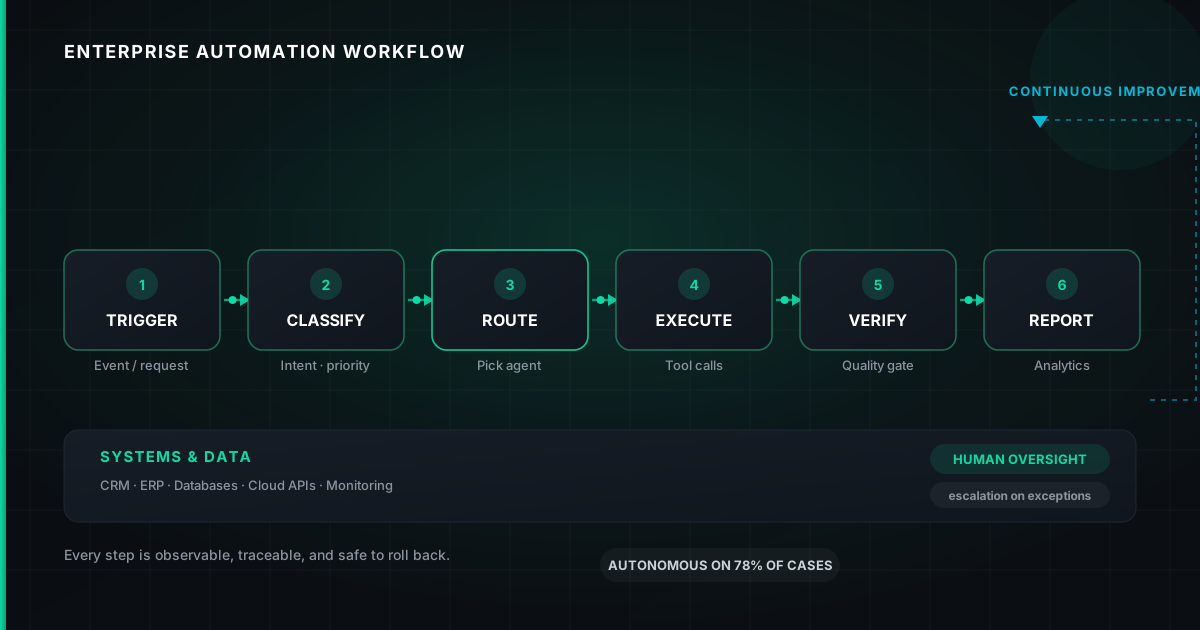
An orchestration layer typically performs five functions. It plans a workflow by decomposing a goal into steps. It routes each step to the right agent, model, or service. It coordinates context through shared memory and knowledge bases. It controls execution with retries, guards, approvals, and policies. And it learns from outcomes to improve future routing. These functions are what separate production intelligent automation from isolated AI demos.
AI orchestration is also the natural evolution of workflow orchestration. The older discipline orchestrated APIs and microservices against fixed schemas. The newer discipline orchestrates autonomous agents that reason about goals. Your existing enterprise workflows do not need to be replaced; they need to be lifted into a control plane that can coordinate both deterministic steps and adaptive AI steps.
It is worth pausing on the difference between orchestration and integration, because the two are frequently conflated. Integration connects systems — it moves data from a CRM to an ERP, or a trigger to a webhook. Orchestration governs behaviour — it decides what should happen, in what order, under what constraints, and what to do when something fails. An integration layer answers "how do systems talk?" An orchestration layer answers "how does work get done?" Most enterprises have the first and are missing the second, which is exactly why their AI initiatives stay stuck in pilot limbo.
This distinction matters for budgeting and ownership. Integration work typically sits with the platform or enterprise architecture team. Orchestration work needs a product owner, because it changes how processes run and who approves them. When you assign orchestration to the same team that runs integration buses, it tends to get treated as plumbing and never reaches the governance layer where the real value lives.
AI orchestration in one sentence
AI orchestration is the control plane that turns scattered AI agents, models, and enterprise systems into one governed, observable, self-improving automation platform.
DID YOU KNOW?
The term "agentic AI" describes systems where AI agents plan and execute multi-step tasks with minimal human intervention. AI orchestration is the engineering practice that makes agentic AI safe and reliable enough for the enterprise.
Why Traditional Automation Is No Longer Enough
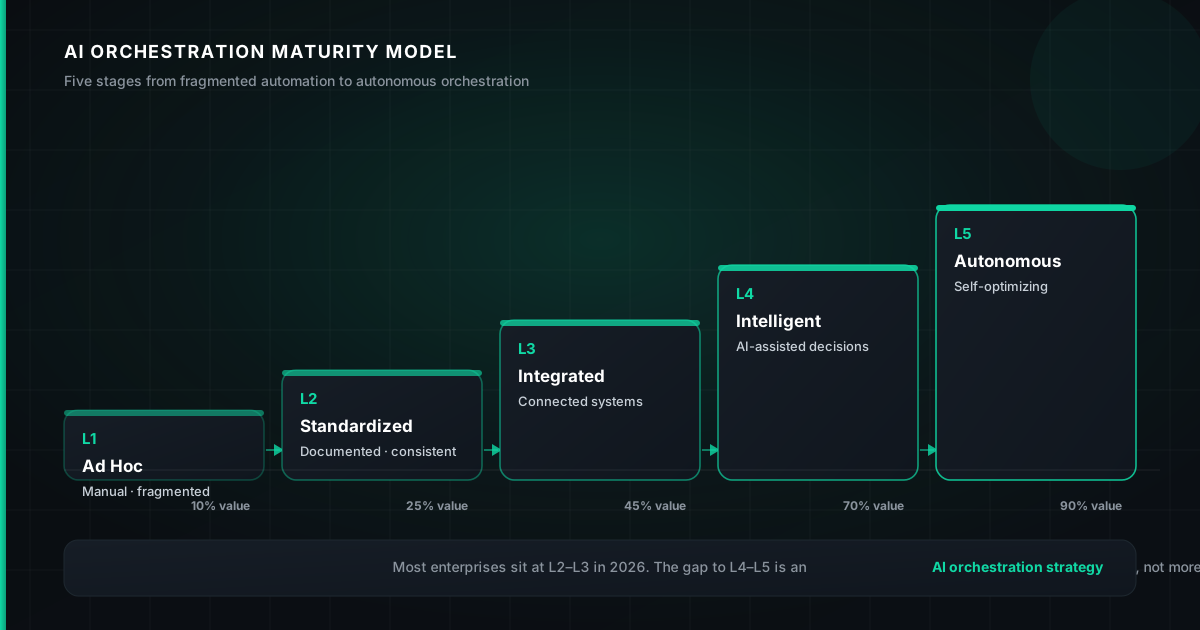
Traditional business process automation was built for a world where inputs were structured, rules were stable, and change was slow. That world is disappearing. Enterprises now face unstructured data everywhere, processes that change monthly, and customers who expect real-time, personalised responses. Rule-based systems strain under exactly the conditions that modern business creates.
Consider what a deterministic workflow does when it meets something it has not seen: a supplier invoice in an unfamiliar format, a customer message written in slang, a logistics delay that changes the plan mid-flight. It raises an exception. Somebody triages it manually. If the exception rate is low, that is fine. But as automation expands into judgement-heavy work, the exception queue becomes the bottleneck — and the automation stops scaling.
AI orchestration changes the economics. Instead of coding every edge case, you give agents the context they need and let them reason about ambiguity. The system still escalates when confidence is low, but it resolves the majority of exceptions autonomously. This is the difference between automating 30% of a process and automating 80% of it.
The 30/80 rule
Deterministic automation typically captures the first 30% of a process — the stable, well-defined steps. AI orchestration attacks the remaining 70%: the exceptions, the judgement calls, and the unstructured inputs. That gap is where most of the cost and most of the value live.
There is also a change-velocity problem that rule-based systems cannot solve. In 2026, business rules change monthly, not annually. Pricing models, compliance requirements, and customer policies shift constantly. A deterministic workflow encodes each rule in brittle logic that must be discovered, tested, and redeployed every time the business changes. An orchestrated workflow expresses intent in one place — the workflow definition — and lets agents adapt the details. The maintenance burden moves from a backlog of rule changes to a version-controlled definition that a business analyst can read.
| Dimension | Traditional Automation | AI Orchestration |
|---|---|---|
| Logic | Explicit, pre-written rules | Planned and adapted by models and agents |
| Inputs | Structured, stable formats | Structured and unstructured, including language, voice, and images |
| Exceptions | Routed to human queues | Resolved by agents with confidence checks |
| Change | Requires rework when rules change | Learns and re-plans as conditions change |
| Observability | Step-level logs | Reasoning traces across agents and models |
| Scalability | Linear with rule and bot count | Non-linear via shared memory and routing |
This does not mean RPA or integration platforms are obsolete. The strongest strategies combine deterministic automation for predictable work with AI orchestration for judgement-heavy work. The orchestration layer becomes the coordinator; RPA bots and APIs become tools that agents can call.
The Limits of Scripts and RPA
Scripts and RPA excel at predictable, high-volume tasks such as data entry, file moves, and screen scraping. They fail when the work requires understanding. A bot cannot interpret an ambiguous email, weigh competing priorities, or explain its reasoning to a regulator. AI orchestration fills that gap by combining the reliability of automation with the reasoning of enterprise AI.
The work that resists automation today falls into a handful of categories, and each one maps to a capability that orchestrated agents bring. Unstructured input — free text, images, and voice — requires models that can parse and classify it. Judgement calls — which discount to offer, which claim to approve — require reasoning over policy and context. Ambiguity — an incomplete form, a vague request — requires asking for clarification instead of guessing. Interdependent steps — decisions that change what happens next — require planning and state. These are precisely the four things deterministic tools handle worst and orchestrated systems handle natively.
From Point Solutions to a Platform
Most enterprises do not have one automation problem; they have fifty. Each team buys a tool, builds a bot, or trains a model. The result is fragmentation: duplicated effort, inconsistent governance, and no shared infrastructure. AI orchestration consolidates these point solutions onto one platform where every workflow shares the same security, monitoring, and approval controls.
The cost of fragmentation is rarely visible in any single budget line. It shows up as teams rebuilding the same document-extraction pipeline, auditors asking for the fifth different model inventory, and security teams chasing shadow AI tools that were never approved. Every point solution carries its own access model, its own logging, and its own failure modes. Consolidating them onto a single orchestration platform is not a nice-to-have; it is how enterprises bring AI under control without slowing it down.
AI Orchestration Architecture
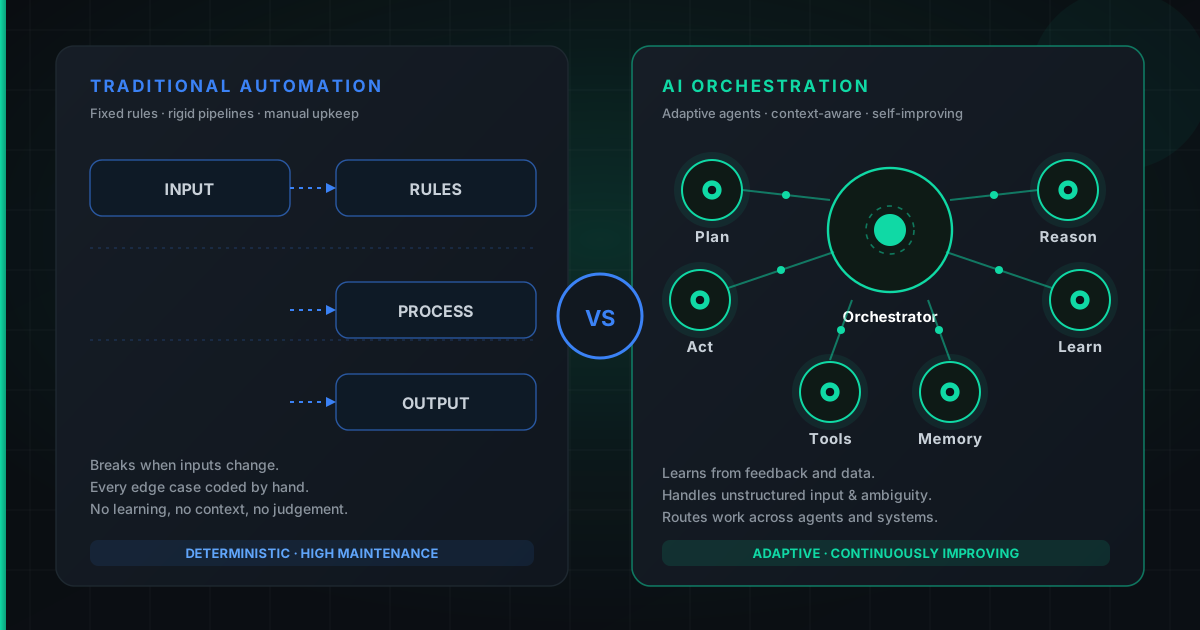
A production AI orchestration platform is a layered system. Each layer has a clear responsibility, and the boundaries between layers are what keep the system secure, testable, and replaceable. The architecture below is the pattern we use when designing enterprise AI solutions for clients, and it applies whether you assemble open-source components or buy a vendor platform.
- Human approval layer — escalation, sign-off, policy checks, and audit for high-stakes decisions.
- Orchestration engine — planning, routing, task graphs, retries, and policy enforcement.
- Intelligence layer — LLMs, AI agents, memory, and knowledge bases that perform the reasoning.
- Integration layer — APIs and connectors that reach CRM, ERP, databases, and legacy systems.
- Security layer — identity, access control, secrets, isolation, and audit trails.
- Observability layer — monitoring, tracing, quality gates, and cost telemetry.
The layers communicate top-down and bottom-up. An approval decision at the top gates a step in the engine; the engine routes to an agent in the intelligence layer; the agent calls a system through the integration layer; and every interaction is captured by the security and observability layers. When this separation is done correctly, you can replace a model without touching the integration layer, or add a new connector without changing the workflow logic. That replaceability is what keeps the platform from becoming the next legacy system.
The Orchestration Engine
The orchestration engine is the brain of the platform. It receives a goal, plans a sequence of steps, and executes them against the available agents and services. Modern engines use explicit task graphs — either hand-authored or dynamically generated by a planner — so teams can see, test, and version every workflow.
A well-designed engine also implements durable execution: if a step fails or the process restarts, the workflow resumes where it left off rather than starting over. This matters enormously in the enterprise, where a failed overnight process is a missed SLA, not a demo glitch.
{
  "workflow": "order-returns-agent",
  "steps": [
    { "id": "intake",    "agent": "classifier",  "input": "customer_message" },
    { "id": "verify",    "agent": "order-lookup", "tool": "crm_api" },
    { "id": "policy",    "rules": "returns_policy", "approval": "if amount > 2000" },
    { "id": "respond",   "agent": "writer",       "guard": "tone_check" },
    { "id": "log",       "tool": "audit_log",     "always": true }
  ],
  "retry": { "max": 3, "backoff": "exponential" },
  "observability": { "trace": true, "emit_metrics": true }
}
Memory and Knowledge
Agents are only as useful as their context. AI orchestration supplies that context through two mechanisms: memory and knowledge. Memory carries state across steps and sessions — what the customer already told us, what the agent decided, what changed. Knowledge grounds responses in approved sources through retrieval-augmented generation, which reduces hallucination and gives every answer a citation trail.
Tools and Integration
An agent without tools is a chatbot. AI orchestration gives agents secure access to tools: databases, APIs, CRMs, ERPs, email, and internal microservices. The integration layer standardises how agents call systems and enforces least-privilege access. This is where AI integration with your existing stack happens, and it is why orchestration platforms extend rather than replace the systems you already run.
async function orchestrate(goal, context) {
  const plan = await planner.plan(goal);          // 1. decompose goal
  let state = { ...context, results: {} };

  for (const step of plan) {
    const agent = router.select(step, state);     // 2. route to agent
    let output = await agent.run(step, state);    // 3. execute
    output = await validator.check(output, step); // 4. quality gate
    if (!output.passed) {
      state = await escalator.raise(step, output); // 5. human approval
    } else {
      state.results[step.id] = output.value;
    }
  }
  return state;
}
Security and Governance
Security in an orchestration platform is not a perimeter; it is a set of boundaries applied at every step. Identity flows with the request — each agent runs under a service account with the least privilege needed for its tools. Secrets never reach the model prompt; they are injected by the platform at call time. And every tool invocation passes through a policy check that can deny, allow, or require approval.
Governance builds on the same primitives. Every workflow definition is versioned and peer-reviewed like code. Every decision records its reasoning trace, so an auditor can ask "why did the system approve this?" and get an answer that is not a shrug. For regulated industries this is the difference between deploying agentic AI and merely demoing it. If your platform cannot produce a complete audit trail from goal to outcome, it is not ready for production.
Observability and Cost Telemetry
Observability in an orchestration platform goes beyond logs. The key artifact is the reasoning trace: a record of every plan, model call, tool result, and policy decision that produced a final outcome. Teams use these traces to debug failures, tune prompts, and justify the system to auditors. Without them, an orchestrated workflow is a black box that occasionally does something wrong and gives no way to find out why.
Cost telemetry is the second non-negotiable. Because each workflow may trigger dozens of model calls, token spend becomes a product cost rather than an infrastructure line item. The platform should attribute cost to the workflow, the step, and the agent, and it should surface drift before the monthly bill does. Teams that measure cost per completed workflow — rather than cost per API call — make routing decisions that compound into six-figure annual savings.
Ready to Architect Your AI Orchestration Layer?
Our enterprise AI engineers will help you design an orchestration platform that fits your existing stack — with governance, security, and observability built in from day one.
Book a Free ConsultationBenefits of AI Orchestration
The benefits of AI orchestration compound because it improves the three things that automation programs measure: speed, cost, and reliability. It also removes the ceiling that deterministic automation hits when work becomes judgement-heavy.
- End-to-end automation. Orchestration completes entire processes — not isolated steps — because agents can hand off work, share context, and handle exceptions.
- Faster cycle times. Routing the right agent to the right step removes queueing and rework. Teams report 30–60% faster case handling.
- Lower operating cost. Autonomous resolution of exceptions and long-tail cases reduces manual effort per transaction.
- Consistent quality. Validation gates, guardrails, and policy checks catch errors before they reach customers or compliance.
- Faster change. When a policy or process changes, you update the workflow definition — not hundreds of brittle rules.
- Governance at scale. One platform applies the same security, audit, and approval controls to every AI workflow.
- Compounding learning. Routing decisions and outcomes feed back, so the system improves without rewriting code.
The benefits reinforce one another, which is why they compound rather than add. Faster cycle times produce more throughput, which generates more outcome data, which improves routing, which cuts cost further. Each orchestrated workflow makes the next one cheaper to build because the platform, connectors, and evaluation tooling already exist. Early adopters describe it as the point where the automation roadmap stops growing linearly and starts growing exponentially.
Why orchestration beats more models
Buying a more capable model gives you incremental intelligence. Orchestration gives you compounding leverage: the same model, routed intelligently, solves problems a single prompt never could.
Measuring the ROI of AI Orchestration
Executives do not fund architectures; they fund outcomes. Building a credible business case for AI orchestration means moving from "the platform is working" to "the business is measurably better." The good news is that orchestration makes ROI easier to measure than most AI investments, because every workflow already has a cost baseline you can capture before you automate it.
The unit of measurement is the completed workflow, not the model call. For each workflow you should know the cost of the manual process today — including the fully loaded cost of the humans handling exceptions — the cycle time, the error rate, and the escalation rate. After orchestration, you measure the same four numbers. The delta is the ROI. This framing avoids the trap of optimising token spend while the actual business problem — too many human touches per transaction — goes unresolved.
| KPI | Baseline (before) | Target (year one) | Cadence |
|---|---|---|---|
| Cost per completed workflow | Manual labour + exceptions | 20–40% reduction | Monthly |
| End-to-end cycle time | Current SLA | 30–60% faster | Weekly |
| Human escalation rate | Percentage of cases touched | Cut in half | Weekly |
| Automation coverage | Share of steps automated | 60–80% of steps | Quarterly |
| Accuracy on eval set | Established threshold | Stable or improving | Weekly |
| Exception resolution time | Triage queue latency | Minutes, not days | Monthly |
Two measurement disciplines make the difference between a business case that lands and one that fades. First, capture the baseline before you build — teams that retrofit the baseline after launch always inflate the numbers. Second, agree on who owns the metric. If the automation team owns cost and the business owns cycle time, nobody owns the outcome. Assign one owner per KPI and review the scorecard monthly in the same meeting where the business reviews its own performance.
Be equally honest about the costs. The platform licence, integration engineering, data cleanup, and ongoing evaluation work are real. A credible model nets these against the savings and still shows a positive return in the first year for any high-volume workflow. If the pilot does not clear that bar, it is the wrong pilot — not the wrong technology.
AI Agents vs AI Orchestration
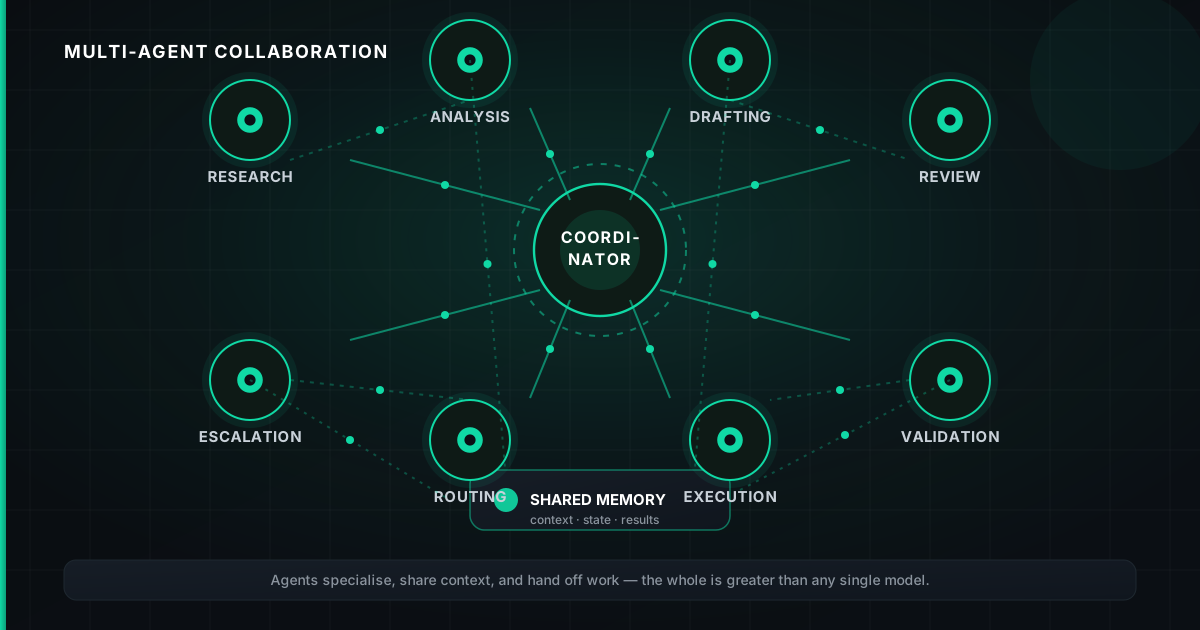
The distinction between AI agents and AI orchestration confuses many teams, and the terms are often used interchangeably. They are not the same thing. An agent is a unit of capability. Orchestration is the system that coordinates those units. You can have agents without orchestration — that is a prototype. You cannot have production agentic AI without orchestration.
| Dimension | AI Agents | AI Orchestration |
|---|---|---|
| Scope | Performs a single task or goal | Coordinates many tasks, agents, and systems |
| Responsibility | Reasoning and acting within its role | Planning, routing, policy, and error handling |
| Context | Limited to its own memory | Shared memory and knowledge across steps |
| Failure | Agent fails or produces low confidence | Orchestration retries, reroutes, or escalates |
| Governance | Often absent by default | Built-in approvals, guards, and audit |
| Example | A claims summariser agent | A platform that runs the full claims journey |
A practical way to think about it: an AI agent answers "what should happen next in this one task?" An AI orchestration platform answers "what is the best way to run this entire process, and what do we do when it goes wrong?" Most enterprises already have scattered agents — chatbots, copilots, summarisers. AI orchestration is how they become a coherent system.
There is a well-worn path that illustrates the relationship. A team starts by building one agent for a single task, like summarising support tickets. It works, so they build a second agent for drafting replies, then a third for updating the CRM. Before long they have three agents, three sets of prompts, three cost budgets, and no way to know which one is hallucinating. That is the exact moment an orchestration layer stops being an option and becomes the thing that keeps the project alive.
Orchestration also solves the control problem that prevents agents from scaling. A single agent can be supervised by eyeballing its output. A dozen agents cannot. The platform supplies the supervision instead: confidence thresholds, validation gates, cost caps, and human escalation. This is why production agentic AI is an orchestration story, not an agent story.
If you are building multi-agent systems, orchestration is not optional. Multiple agents without coordination produce conflicting outputs, lost context, and uncontrolled costs. The orchestration layer is what makes multi-agent AI collaborative instead of chaotic. For a deep dive into agent teamwork, see our guide to multi-agent AI systems orchestration.
Move From Scattered Agents to a Coherent System
Most enterprises already have agents — chatbots, copilots, and summarisers. We help you orchestrate them into one governed, observable platform before costs and risks multiply.
Book a Free ConsultationEnterprise Use Cases for AI Orchestration
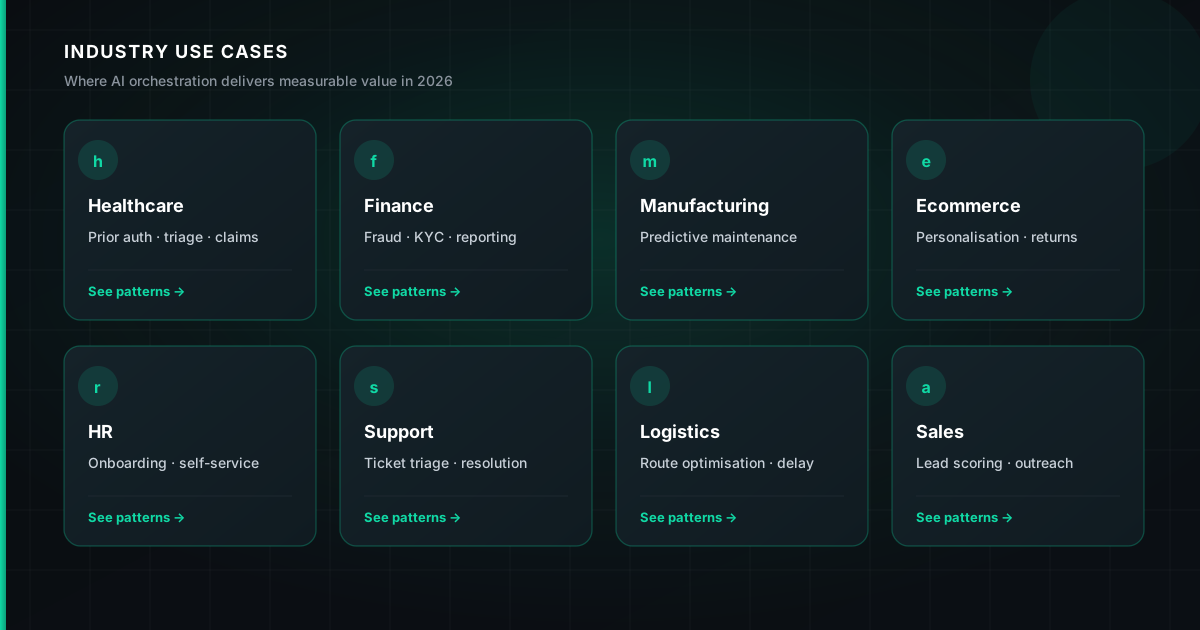
The most useful way to evaluate AI orchestration is through the workflows it improves. Across every industry, the same pattern repeats: a high-volume process with ambiguity, unstructured input, and multiple handoffs becomes faster, cheaper, and more consistent when orchestrated. Below are the use cases we see deliver the strongest enterprise automation results in 2026.
Healthcare
Healthcare is drowning in unstructured information: clinical notes, prior authorizations, claims, and referrals. AI orchestration coordinates agents that extract data from documents, match patients to authorization criteria, draft responses, and escalate borderline cases to clinicians. The approval layer keeps every decision human-reviewed where regulations require it, while the orchestration layer removes the administrative backlog.
A health system running orchestrated prior authorization can cut turnaround from days to hours, reduce denials, and give clinical staff their time back. Compliance benefits from a complete audit trail of every AI step.
The same pattern extends to clinical documentation and revenue cycle management. A documentation agent turns recorded conversations into structured notes; a coding agent suggests billing codes; a claims agent checks for missing fields before submission. Each step is orchestrated with human review where a misstep could affect a patient or a payment. Health systems that combine these workflows report administrative cost reductions in the double digits while clinician satisfaction rises, because the system removes work rather than adding clicks.
Finance
Banks and insurers use AI orchestration for onboarding, fraud detection, and regulatory reporting. Agents classify transactions, assess risk, draft suspicious activity reports, and reconcile accounts. Because financial services are heavily regulated, orchestration's approval layer and traceability are not nice-to-haves; they are what make agentic AI deployable at all.
In loan origination, an orchestrated pipeline can collect documents, verify income, check credit, summarise the file, and recommend conditions — with underwriters reviewing the recommendation instead of assembling the file from scratch. The result is faster decisions with fewer manual touches.
Manufacturing
Manufacturers orchestrate agents across demand forecasting, production scheduling, quality control, and predictive maintenance. Sensor data feeds a monitoring agent; an optimisation agent proposes schedule changes; a planner agent coordinates suppliers; and a human approval layer gates changes that affect customer commitments.
The payoff is resilience. When a supplier misses a shipment or a line goes down, the orchestrated system re-plans automatically instead of waiting for a planner to notice. Downtime shrinks, inventory optimises, and the factory absorbs disruption.
Ecommerce
AI orchestration powers the modern commerce stack: personalisation, inventory, pricing, returns, and support. Agents track demand signals, adjust recommendations, and route returns conversations. An orchestrated returns workflow classifies the reason, checks policy, generates a label, updates inventory, and issues the refund — resolving the customer's issue in minutes instead of days.
Because ecommerce runs on thin margins, the cost savings from autonomous long-tail handling are immediate. Fewer refunds due to policy errors, fewer manual interventions, and faster resolution directly improve unit economics.
HR
HR teams orchestrate onboarding, employee self-service, leave requests, and knowledge answers. An orchestrated onboarding workflow gathers paperwork, provisions accounts, schedules training, and answers the new hire's questions with an agent grounded in the employee handbook — while HR keeps approval over anything unusual.
The benefit is scale without headcount. A single orchestrated HR workflow can absorb hundreds of routine requests a day, and the audit trail simplifies compliance with employment regulations.
Customer Support
Support is the most mature AI workflow automation use case. Orchestration changes support from a queue to a system: an intake agent classifies intent and sentiment, a resolution agent searches knowledge and takes action, a writer agent drafts the reply, and a quality gate checks tone and accuracy before anything reaches the customer. Complex cases escalate to humans with full context.
The result is higher containment, faster first response, and agents that are actually useful because they can perform actions — not just talk. Support teams stop doing triage and start handling the cases that need human judgement.
Logistics
Logistics operates on constant disruption. Orchestrated systems monitor carriers, ports, and weather; predict delays; re-optimise routes; and notify customers before they ask. An agent reads carrier delay notifications in natural language, an optimiser proposes alternatives, and a planner coordinates with warehouse execution — all under policy constraints and human override for high-cost decisions.
The compounding benefit in logistics is that each orchestrated decision updates the model for the next one. A delay prediction that is confirmed by the carrier trains the system to trust that signal more next time. Freight spend, detention fees, and missed delivery windows all improve as the platform learns which signals actually predict disruption. Operators move from reacting to disruptions after they happen to steering around them before they do.
Sales
Sales teams orchestrate lead scoring, outreach, follow-ups, and forecasting. Agents enrich leads, draft personalised sequences, score readiness, and update the CRM. The orchestration layer ensures every action complies with consent rules and that salespeople see a coherent picture rather than a pile of disconnected tools.
The less obvious win is forecasting. Because the orchestration platform sees the whole pipeline — how leads entered, how they were engaged, what converted — it produces forecasts that are grounded in the actual process rather than a rep's optimism. Sales leaders get a view of "why is the pipeline moving or stuck" that no CRM dashboard alone provides. And because every outreach action is logged against consent policy, the compliance team signs off once instead of auditing each campaign.
AI Orchestration Platforms in 2026
The AI orchestration platform market matured dramatically in 2025 and 2026. There are now four credible paths to build an orchestration layer: purpose-built platforms, agent frameworks, general workflow engines, and cloud-native stacks. Your choice depends on how much control you need, how regulated your domain is, and how much of your stack you want to own.
| Approach | Examples | Best for | Watch for |
|---|---|---|---|
| Purpose-built orchestration platforms | LangGraph, Temporal-based agents, vendor BPM+AI suites | Production agentic workflows with state, retries, and approval | Vendor lock-in, per-seat cost |
| Agent frameworks | LangChain, CrewAI, AutoGen, Semantic Kernel | Rapid experimentation and custom multi-agent logic | Missing durability and governance by default |
| Workflow engines with AI steps | n8n, Airflow, Temporal, Azure Logic Apps | Teams that already orchestrate APIs and want to add AI steps | Weaker agent-native coordination |
| Cloud-native AI stacks | AWS Bedrock Agents, Azure AI Agent Service, Vertex AI Agent Builder | Enterprises standardising on one cloud provider | Cross-cloud portability |
The frameworks you choose matter less than the pattern you follow. Successful implementations separate the orchestration layer from the models and systems it coordinates, so you can swap a model, an agent, or a vendor without rewriting the process. That separation is the defining feature of a mature AI orchestration platform.
A pragmatic roadmap: prototype with an agent framework, then move the winning workflows onto an orchestration platform with durable execution, guardrails, and audit. Do not let a demo framework become your production governance layer.
Evaluation Criteria for Platforms
When you shortlist platforms, resist the demo. Every vendor's demo works on their own clean data. Instead, score each platform against the capabilities that determine whether it survives contact with your enterprise. Run a proof of concept against a real workflow, with real data, and let your engineers break it.
Platform evaluation scorecard
- Durable execution: does the workflow survive restarts, retries, and partial failures mid-step?
- Approval and policy controls: can non-engineers define who approves what, with an audit trail?
- Reasoning observability: can you see the full trace from goal to outcome, including model calls?
- Connector breadth: does it reach your CRM, ERP, databases, and legacy systems natively?
- Model portability: can you swap models and vendors without rewriting the workflow?
- Cost controls: are there budgets, caps, caching, and model routing built in?
- Security model: least-privilege access, secrets handling, and isolation for sensitive data?
- Escape hatch: can you export workflows and move to another platform if needed?
Evaluating orchestration platforms
Score platforms on five capabilities: durable execution, policy and approval controls, observability with reasoning traces, connector breadth, and model portability. A demo that impresses is not the same as a platform that governs.
A Pragmatic Implementation Roadmap
The difference between a successful orchestration program and a stalled one is rarely the technology. It is the sequence. Teams that try to orchestrate everything at once drown in integration work and governance debates. Teams that pick one bounded workflow, prove the economics, and then expand, build momentum that survives budget cycles and leadership changes.
| Phase | Focus | Duration | Exit criteria |
|---|---|---|---|
| Discover | Map workflows; score by volume, variability, impact | 2–3 weeks | One pilot workflow selected with baseline metrics captured |
| Prototype | Build the workflow with an agent framework; prove accuracy | 3–5 weeks | 80%+ accuracy on eval set; cost per workflow modelled |
| Pilot | Move to an orchestration platform; wire real systems; approvals | 6–12 weeks | ROI clears target; escalation rate within guardrails |
| Scale | Add workflows; standardise governance; automate approvals | Quarterly | New workflow onboarding in weeks, not months |
| Optimise | Model routing, caching, and continuous evaluation | Ongoing | Cost per workflow falls while quality holds |
Three principles keep the roadmap on track. First, the pilot must be bounded — one workflow, one region, one product line. A pilot that touches every business unit is a transformation program with a pilot's budget. Second, the baseline must be real. Capture cost, cycle time, and escalation rate before you change anything; you will need those numbers to defend the next phase. Third, the pilot needs a named business owner with a stake in the outcome, not just a technical sponsor.
PRO TIP
Pair the pilot with the most expensive manual process you can name. The bigger the baseline cost, the clearer the ROI story — and the more likely the pilot survives its own budget review.
As you scale, resist the urge to special-case every workflow. The value of the platform comes from reuse: the same connectors, governance, evaluation sets, and dashboards serving every workflow you add. A good test of maturity is whether a new workflow can be modelled, wired, and shipped in weeks using components that already exist — rather than starting from a blank sheet each time.
For enterprises that lack an existing integration layer or data platform, the discovery phase should include a parallel workstream to clean up the plumbing. Orchestration amplifies whatever it runs on. If the underlying systems are healthy, the platform delivers compounding value; if they are not, it will expose every weakness at once. Spend the first phase confirming the foundation before you build the house.
Launch a 6–12 Week Orchestration Pilot
We'll score your workflows, pick one high-value bounded process, and prove the ROI with real baseline metrics — then scale incrementally with governance built in.
Book a Free ConsultationChallenges in AI Orchestration
AI orchestration is powerful, but it is not easy. The challenges are less about models and more about the realities of enterprise systems, data, and governance. Teams that name these risks early avoid the most expensive failures.
- Legacy integration. Old systems lack clean APIs, so orchestration must work through adapters, databases, and event streams. Budget time for this; it is the most common schedule risk.
- Data quality. Orchestration amplifies the data it consumes. Bad data produces confidently wrong outcomes. Fix the data pipelines before you scale agents.
- Model cost and latency. Every orchestrated step can mean multiple model calls. Token spend and response latency compound quickly without routing and caching.
- Governance and compliance. Regulated industries need audit trails, approval gates, and model explainability built into the platform, not added later.
- Security boundaries. Agents with tool access are powerful and dangerous. Least-privilege access, secrets management, and isolation are mandatory.
- Talent. Designing reliable agentic workflows is a new skill. Teams need prompt engineering, evaluation, and systems thinking, not just ML expertise.
- Organisational resistance. Automation changes roles. Teams that skip change management build systems people quietly work around.
COMMON MISTAKES
- Buying a platform before mapping the workflows — you will select on features, not fit.
- Piloting five workflows at once — you get a transformation program with a pilot's budget.
- Skipping the baseline — without it you cannot prove ROI, and the business case collapses.
- Letting the demo become the governance layer — prototype with a framework, but move production work onto durable orchestration.
The pattern worth naming is that most of these challenges are governance and engineering problems, not model problems. The models are largely solved; the infrastructure around them is not. Teams that treat orchestration as an architecture programme — with a real owner, a budget, and an operating model — absorb these risks. Teams that treat it as a tool installation hand the same risks to whoever happens to support the tool next quarter.
Cost and Latency Control
The most common operational surprise is the cost of multi-agent loops. Each agent call is a model call, and loops multiply token spend. Mature platforms control this with model routing — cheap models for simple steps, expensive models for hard ones — plus caching, batching, and budget caps per workflow. Measure cost per completed workflow, not cost per API call.
| Failure mode | Signal | Fix |
|---|---|---|
| Hallucinated outputs | Low accuracy on eval set | Ground with RAG; add validation gates |
| Runaway loops | Cost spikes, timeout alerts | Step budgets, max-iteration caps, circuit breakers |
| Conflicting agents | Outputs contradict each other | Shared state, explicit handoffs, coordinator agent |
| Silent failures | Process stops without alert | Durable execution, health checks, alerting |
| Policy violations | Compliance findings | Approval layer, policy engine, audit logs |
Best Practices for AI Orchestration
After building and operating AI orchestration systems across industries, we have condensed what works into a set of repeatable practices. Apply these from day one and you avoid most of the cost, quality, and governance problems that sink AI automation programs.
Adoption checklist
- Score your workflows by volume, variability, and business impact; orchestrate the high-value, judgement-heavy ones first.
- Automate the deterministic parts with existing tools and reserve agents for work that needs understanding.
- Ground every agent in approved knowledge sources to reduce hallucination and give citations.
- Build validation gates and confidence thresholds before any agent action is final.
- Define escalation to humans with full context, not just a notification.
- Put approval, audit, and security controls in the platform, not in prompts.
- Measure cost per completed workflow and route cheap models to simple steps.
- Run evaluation sets that track accuracy, latency, cost, and escalation rate weekly.
- Treat every workflow definition as versioned, tested infrastructure.
- Plan change management with the teams whose work is being automated.
A governance pattern that works well is a human approval layer that is explicit about what it gates. Approvals should apply to high-value, irreversible, or regulated actions — issuing a refund over a threshold, sending a legal notice, changing a customer commitment. Everything else runs autonomously, with full audit. This keeps the system fast where speed is safe and controlled where it matters.
Operationally, the team that runs orchestration looks less like a traditional ops team and more like a product squad. It owns a roadmap of workflows, a backlog of evaluation findings, and a weekly review of the scorecard. Prompt engineers, platform engineers, and business analysts work against the same workflow definitions, which are versioned, reviewed, and rolled back like any other deployment. This operating model — rather than any single tool — is what separates orchestration that compounds from orchestration that petrifies.
Future Trends in AI Orchestration
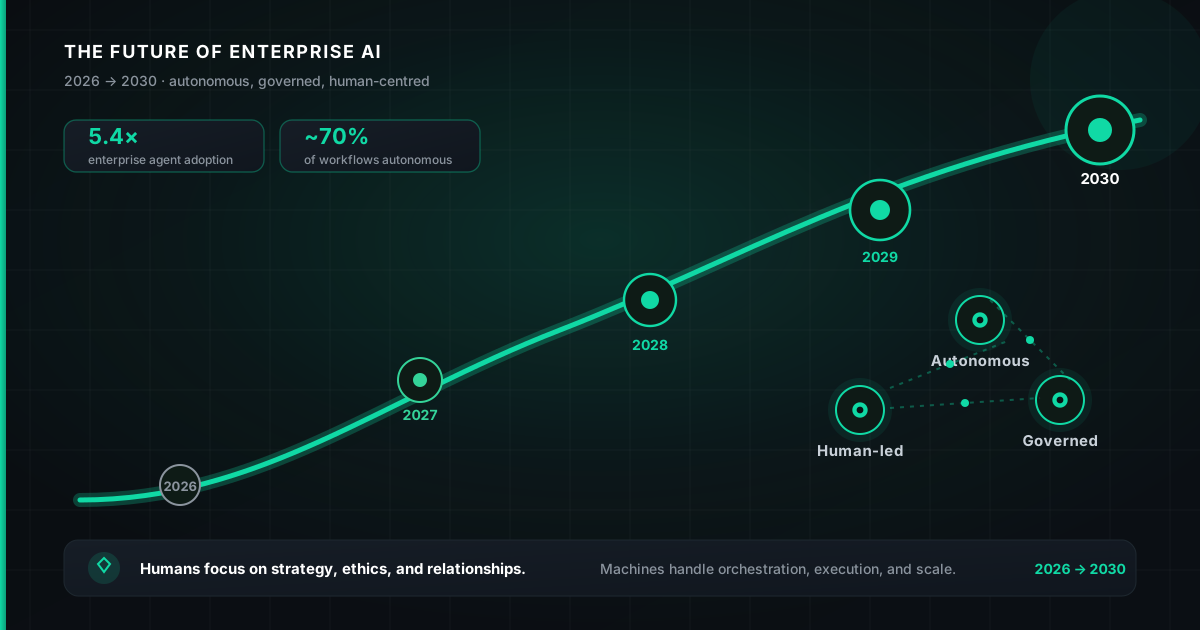
AI orchestration is still early in its curve, and 2026 is the year the architecture standardises. Several trends will shape the next few years of enterprise AI.
Autonomous Multi-Agent Systems
Enterprises are moving from single assistants to multi-agent systems where specialist agents coordinate under an orchestrator. The orchestration layer is what makes these systems safe enough to trust with end-to-end processes, and it will become as standard as CI/CD is for software delivery.
Durable and Event-Driven Orchestration
Durable execution — workflows that survive restarts and resume mid-step — is becoming the default. Combined with event-driven triggers, orchestration will run continuously in the background, reacting to business events in real time rather than on a schedule.
Vertical and Embedded Orchestration
Industry-specific orchestration will appear in every enterprise application: healthcare platforms, banking suites, and supply chain systems will ship with orchestration built in. Buying an application will increasingly mean buying an AI orchestration platform underneath it.
Governance as Code
Approval policies, audit rules, and security boundaries will be expressed as code and versioned alongside workflows. Regulators will expect this level of control, and organisations that build governance into the platform will move faster than those retrofitting it.
Agentic RPA and Legacy Modernisation
The RPA estates that enterprises spent a decade building will not be thrown away; they will be re-skinned. Orchestration platforms will treat RPA bots as just another tool an agent can call — a legacy bot doing screen scraping for the steps no API can reach, while agents handle the reasoning around it. This hybrid pattern lets enterprises modernise in place, adding intelligence to existing automation instead of replacing it. Expect the biggest near-term wins to come from retrofitting, not greenfield projects.
Designing the Human-AI Workforce
As orchestration takes over more execution, the scarce resource becomes the humans who define, supervise, and improve the workflows. Enterprises will re-organise around the human-AI boundary: humans own outcomes and exceptions, systems own execution and scale. The leaders who succeed will treat this as an operating-model change — new roles, new review cadences, new promotion criteria — not just a technology rollout. The companies that treat it as an IT project will watch their best operators leave while their automation quietly runs untended.
Frequently Asked Questions
Here are the questions we hear most often from enterprise teams evaluating AI orchestration.
- What is the fastest way to prove AI orchestration value?
- Can we orchestrate agents without replacing our existing systems?
- Do we need a data science team to build orchestration?
- How do we control cost as workflows scale?
- Is AI orchestration relevant for small and mid-sized companies?
Full answers for these and more are in the FAQ section below. If you would rather talk to an engineer, book a call with our team and we will map your highest-ROI workflow with you.
Conclusion
AI orchestration is the most important architectural shift in enterprise automation since the arrival of cloud computing. It turns scattered AI agents, models, and enterprise systems into a governed platform that plans, routes, learns, and scales. It is the difference between a collection of impressive AI demos and an enterprise AI strategy that compounds.
The playbook is consistent across every industry we serve: score your workflows, pick one high-value bounded process, wire in the existing systems, put governance and human approval in the platform, measure relentlessly, and scale incrementally. Done well, orchestration delivers faster cycles, lower cost, better quality, and a foundation your organisation can build on for a decade.
The window for early advantage is open now. Teams that build the orchestration layer in 2026 will have cleaner architectures, better data pipelines, and stronger governance when autonomous systems become table stakes. Teams that wait will rebuild under pressure.
We have covered a lot of ground, so here is the whole argument in three sentences. Traditional automation captures the stable 30% of a process; orchestration attacks the judgement-heavy 70% that deterministic tools cannot reach. The architecture is the product — approval, orchestration, intelligence, integration, security, and observability as separate, replaceable layers. And the economics compound when you score workflows, pilot one bounded process, measure cost per completed workflow, and scale with governance built in. That sequence works in every industry we serve, and it will still work when the models underneath are twice as capable.
"The companies that win with AI are not the ones with the smartest model. They are the ones that can coordinate their models, agents, and systems into processes that run reliably at scale."
Build Your AI Orchestration Strategy
Talk to our enterprise AI engineers about orchestrating your highest-value workflows. We will assess your automation maturity and define a pilot that delivers measurable ROI.
Book a Discovery CallKEY TAKEAWAYS
- 1AI orchestration is the control plane that coordinates agents, models, and enterprise systems into one governed platform.
- 2Traditional automation executes fixed rules; orchestration plans adaptive workflows and handles exceptions autonomously.
- 3Start with one high-value, judgement-heavy workflow, then scale with governance and human approval built in.
- 4Measure cost per completed workflow, not cost per API call, and route cheap models to simple steps.
- 5The architecture — approval, orchestration, intelligence, integration, security, observability — is what makes agentic AI deployable.
Frequently Asked Questions
AI orchestration is the discipline and technology layer that coordinates AI agents, foundation models, data systems, and enterprise applications to execute complex workflows end to end. It handles planning, routing, memory, tool calling, error handling, human approval, security, and observability so that AI capabilities can operate reliably inside business processes.
Written by Parth
Parth leads AI and digital transformation engagements at DiVentra Labs. He helps CTOs and automation leaders design AI orchestration platforms, build production multi-agent systems, and turn scattered pilots into governed enterprise automation that delivers measurable ROI.
Connect on LinkedInEngineering Insights in Your Inbox
Get practical guides on AI, custom software, and digital transformation. No spam, unsubscribe anytime.
Related Reading


Where individual agents end and the orchestration layer begins — the distinction that matters for production.
A hands-on comparison of purpose-built platforms, agent frameworks, workflow engines, and cloud-native stacks.
A practical field manual for building a governed enterprise AI strategy that compounds.
What autonomous multi-agent systems mean for your organisation between now and 2030.