
AI Agent Development Cost in 2026: Complete Pricing Guide for Businesses
Vendor quotes for AI agents range from $10K to $500K with almost no transparency. Here is what actually drives AI agent development cost in 2026, component by component, plus the ongoing token and maintenance bills nobody warns you about.
Ask five vendors what it costs to build an AI agent and you will get five numbers spanning an order of magnitude: $10,000, $75,000, $250,000, more. The range exists not because vendors are guessing randomly, but because "AI agent" describes everything from a weekend chatbot wrapper to a governed multi-agent platform running mission-critical operations.
This guide gives you the numbers we use when scoping real engagements: realistic price bands by complexity, a line-by-line breakdown of where the money goes, the recurring costs that surprise buyers after launch, and practical ways to reduce spend without shipping something fragile. No sales fluff — if a cheaper option fits your case, we say so.
Quick Answer: What AI Agents Cost in 2026
Those bands assume professional engineering — evaluation harnesses, guardrails, observability, proper data handling. Quotes far below these ranges usually mean demo-quality deliverables; quotes far above usually mean enterprise consulting overhead rather than proportionally more engineering.
Budget rule of thumb
Plan the total first-year cost as build price plus 30–40% for tokens, infrastructure, and iteration. An agent that costs $60,000 to build realistically costs $80,000–$85,000 in year one.
The Three Complexity Tiers (and What Fits Where)
Tier 1: Single-Task Agent — $15,000 to $40,000
One input type, one job, one system touched. Examples: a support-ticket triage agent that classifies and routes into Zendesk; an invoice-extraction agent feeding QuickBooks; an internal HR policy Q&A grounded on your handbook. These ship fast because scope is narrow, data is contained, and failure modes are enumerable.
- Timeline: 4–8 weeks including production hardening.
- Includes: prompt/tooling pipeline, one integration, basic evaluation set, logging dashboard.
- Best fit: proving ROI on one painful workflow before committing to a platform.
Tier 2: Integrated Workflow Agent — $40,000 to $100,000
Multiple steps, multiple systems, real accountability. Think lead-qualification agents that read CRM history, enrich from external sources, score, draft outreach, and book meetings — with human approval gates. This tier adds RAG over your knowledge bases, two to four integrations, role-based permissions, and structured evaluation.
- Timeline: 8–14 weeks.
- Includes: RAG pipeline with your data, multi-system orchestration, audit trails, staging environment, handover documentation.
- Best fit: revenue or operations workflows where errors carry visible business cost.
Tier 3: Enterprise Multi-Agent System — $100,000 to $300,000+
Coordinated agent teams with governance: orchestrator patterns, specialist agents, escalation policies, compliance controls, and organization-wide observability. Our guide to multi-agent AI systems covers the architecture driving these builds. Pricing at this tier is dominated by integration breadth and compliance requirements, not model work.
- Timeline: 4–6 months to production, then continuous iteration.
- Includes: orchestration layer, security review, SSO/RBAC, evaluation pipelines in CI, SLA-grade monitoring.
- Best fit: regulated industries and processes spanning departments.
Where the Money Actually Goes: Line-by-Line Breakdown
Headline numbers hide the structure. Here is how a representative Tier 2 engagement ($70,000) decomposes in our scoping experience:
| Component | Share | Typical Range | What It Covers |
|---|---|---|---|
| Discovery & solution design | 10–15% | $7K–$10K | Workflow mapping, success metrics, architecture, data audit |
| Data preparation & RAG | 15–25% | $10K–$17K | Cleaning, chunking, embeddings, retrieval tuning |
| Core agent development | 25–35% | $18K–$24K | Reasoning loop, tools, prompts, fallbacks |
| Integrations | 15–25% | $10K–$18K | CRM/ERP/ticketing connectors, error handling, retries |
| Evaluation & testing | 10–15% | $7K–$10K | Golden datasets, regression suites, red-teaming |
| Security, guardrails & review | 5–10% | $3K–$7K | PII handling, injection defenses, permission checks |
| Deployment & observability | 5–10% | $3K–$7K | CI/CD, dashboards, alerting, cost telemetry |
PRO TIP
When comparing quotes, ask every vendor to price these seven lines separately. Vendors who cannot split discovery from development are usually estimating enthusiasm, not scope.
The Ongoing Costs Nobody Puts in the Proposal
Development is the visible half. After launch, three recurring bills determine whether your agent stays economical:
- LLM token spend: driven by context size and volume. A support agent answering 5,000 tickets monthly with retrieval-augmented context might consume $150–$800/month in frontier-model tokens — or under $50 using smaller models with smart routing.
- Infrastructure: vector databases, API gateways, logging, eval runners — typically $100–$1,000/month managed, less on reserved cloud capacity.
- Maintenance & iteration: prompts decay as products and policies change. Budget 15–20% of build cost annually, or a $2,000–$8,000/month retainer for actively evolving agents.
DID YOU KNOW?
Token costs fall every year — frontier-model pricing dropped roughly an order of magnitude between 2023 and 2026 — but total agent spend often still rises, because successful agents earn expanded scope. Budget growth here is a good problem.
In-House vs Agency vs Off-the-Shelf: The Real Math
Off-the-shelf platforms win on speed and floor cost: $20–$500/month gets you usable automation for standard workflows on clean SaaS data. They lose when you need proprietary grounding, custom integrations, compliance posture, or behavior that differentiates your product.
In-house pods make sense at sustained roadmap scale. Two senior engineers plus fractional PM/design run $30,000–$45,000/month fully loaded; your first production agent lands in month 3–4. Compare that against agency pricing for the same scope and break-even usually arrives around the third or fourth substantial build.
| Path | First-Year Cost | Time to Production | Best When |
|---|---|---|---|
| Off-the-shelf platform | $1K–$6K | Days–weeks | Standard workflows, non-differentiating |
| Specialized firm (scoped) | $50K–$150K | 6–12 weeks | Need speed + production quality without hiring |
| In-house team | $120K–$250K | 3–4 months | Multi-year, multi-agent roadmap ahead |
Hybrid is common and sensible: buy the platform for back-office basics, invest custom engineering only where the workflow touches customers or competitive advantage. If you are weighing the hiring path, our breakdown of dedicated teams versus staff augmentation covers the team-shape math.
Seven Factors That Swing Your Quote
- Data readiness: clean, centralized, accessible data cuts RAG work dramatically; scattered PDFs and tribal knowledge multiply it.
- Integration depth: every legacy system with thin APIs adds connector, reconciliation, and edge-case cost.
- Accuracy requirements: 85% acceptable triage accuracy is cheap; 99% auditable financial accuracy demands evaluation infrastructure that dominates budget.
- Compliance surface: HIPAA/SOC2/PCI postures add security engineering, audit logging, and deployment constraints.
- Human-in-the-loop complexity: approval chains, escalation policies, and audit UIs are product work, not model work.
- Latency tolerance: near-real-time agents need streaming infrastructure and aggressive caching.
- Scale trajectory: designing for 100 users versus 100,000 changes architecture choices early.
COMMON MISTAKES
- Comparing bids on headline price instead of line-item scope — the cheap bid usually omits evaluation and guardrails you will pay for anyway after an incident.
- Skipping discovery to 'save money', then paying triple during development to rediscover requirements.
- Ignoring token economics until month three, when usage-based invoices arrive.
- Buying Tier 3 architecture for a Tier 1 problem because 'agents' sounded strategic.
- No evaluation dataset — making every improvement debate a matter of opinion instead of measurement.
How to Reduce Cost Without Building Something Fragile
- Start with one workflow that already has measurable baseline metrics — proving value small makes funding the rest rational.
- Use smaller models with routing: frontier models only where reasoning demands it; 80% of calls often run fine on cheaper models.
- Constrain before you free: rule-based pre/post-processing around the agent removes entire categories of failure (and evaluation cost).
- Reuse integration patterns: if a vendor already built your CRM connector before, insist on pricing that reflects it.
- Invest in evaluation early: a $5,000 golden dataset saves five figures of debate and regression churn later.
"The cheapest AI agent is the one scoped tightly enough to prove ROI in eight weeks. Every failed enterprise agent project we have inherited died from scope obesity in v1, not from technical difficulty."
Framing ROI So the Numbers Approve Themselves
Agents justify cost through three levers: labor hours redirected (tickets deflected, documents processed), revenue velocity (faster lead response, higher conversion), and error reduction (fewer compliance misses, refunds, rework). Anchor the build cost against twelve months of the most conservative lever estimate. A $60,000 agent replacing 1.5 FTE-hours of daily triage across a support team pays back inside a quarter at typical loaded labor rates.
For the strategic backdrop — which workflows suit agents at all versus deterministic automation — read our AI agents versus traditional automation comparison, and our enterprise AI orchestration guide for scaling beyond the first agent.
Pre-Quote Checklist: Arrive Ready, Save Thousands
Bring these to your first vendor conversation
- One named workflow with its current volume, cycle time, and error rate.
- Access inventory: which systems hold the data, and how their APIs are documented.
- One privacy/compliance constraint stated up front (data residency, PII classes).
- A measurable success definition — even 'cut first-response time 30%' suffices.
- A realistic budget band and honest timeline expectation.
- An owner: one person empowered to answer questions within 24 hours during the build.
Conclusion: Price Follows Scope, Not Hype
AI agent development costs $15,000–$40,000 for a focused pilot, $40,000–$100,000 for integrated workflow agents, and $100,000–$300,000+ for governed enterprise systems — plus honest ongoing token, infrastructure, and maintenance spend. Every number moves with data readiness, integration depth, and accuracy requirements, which is exactly why line-item transparency matters more than any headline figure.
At DiVentra Labs we scope AI agent engagements with these exact line items — discovery through observability — so you can see what you are buying before you buy it. If you want a second opinion on a quote you have received, or a scoped plan for your first (or next) agent, that conversation is free and concrete.
Get a Fixed-Scope AI Agent Estimate
Send us your workflow — we will return a line-itemed cost breakdown and an honest go/no-go read within a week. No deck, no pressure.
Book My Free Scoping CallExplore Our AI Development Services
From single-task agents to orchestrated multi-agent platforms, see how we ship production AI systems.
View AI Development ServicesKEY TAKEAWAYS
- 1Realistic 2026 build bands: $15K–$40K single-task, $40K–$100K integrated workflow, $100K–$300K+ enterprise multi-agent.
- 2First-year reality = build price + 30–40% for tokens, infrastructure, and iteration.
- 3Demand line-item quotes: discovery, data/RAG, development, integrations, evaluation, security, deployment.
- 4Off-the-shelf wins for standard internal workflows; custom earns its keep on differentiation, compliance, and deep integration.
- 5Scope tight, measure baseline, and fund expansion from proven ROI — not from slideware.
Frequently Asked Questions
A focused single-task agent typically costs $15,000–$40,000. Mid-complexity agents with integrations and RAG run $40,000–$100,000. Enterprise multi-agent systems range from $100,000 to $300,000+. Ongoing LLM token and infrastructure costs add $200–$5,000+ per month depending on volume.
Written by DiVentra Team
The DiVentra Labs engineering team designs and builds AI orchestration platforms, enterprise AI solutions, and intelligent automation for businesses worldwide. We help CTOs and engineering leaders turn disconnected workflows into governed, self-improving systems.
Engineering Insights in Your Inbox
Get practical guides on AI, custom software, and digital transformation. No spam, unsubscribe anytime.
Related Reading
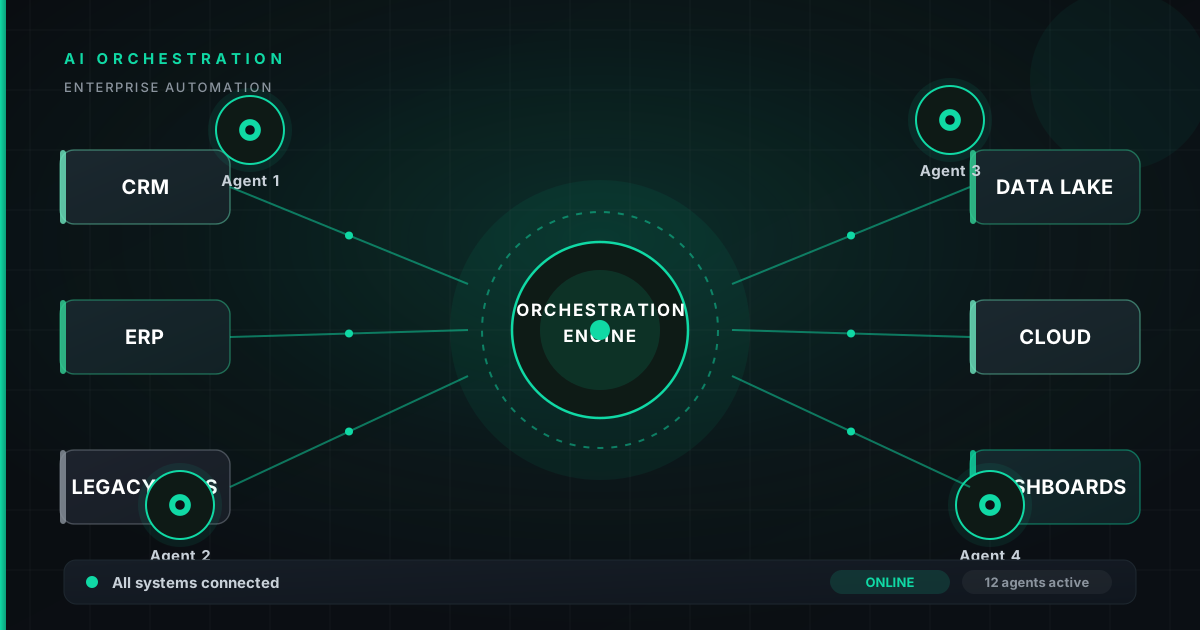
Where individual agents end and the orchestration layer begins — the distinction that matters for production.
A hands-on comparison of purpose-built platforms, agent frameworks, workflow engines, and cloud-native stacks.
A practical field manual for building a governed enterprise AI strategy that compounds.
What autonomous multi-agent systems mean for your organisation between now and 2030.